Diode Current Equation
Diode Current Equation
The diode current equation expresses the relationship between the current flowing through the diode as a function of the voltage applied across it. Mathematically the diode current equation can be expressed as: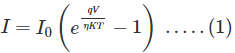
Where,
- I is the current flowing through the diode
- I0 is the dark saturation current,
- q is the charge on the electron,
- V is the voltage applied across the diode,
- η is the (exponential) ideality factor.
 is the Boltzmann constant
- T is the absolute temperature in Kelvin.
This equation primarily focuses on two critical parameters.
Two important diode parameters are I₀ and η.
🔹 Dark Saturation Current (I₀)
Poor material quality → high I₀.
I₀ tells how much unwanted leakage current flows in a diode.
🔹 Ideality Factor (η)
🔹 Forward Bias Condition
I₀ is the small leakage current that flows in a diode even when no light is present and the diode is reverse biased.
It shows how much charge recombination happens inside the diode.
More recombination → higher I₀.
I₀ increases when temperature increases.
Good material quality → low I₀
η shows how close a real diode is to an ideal diode.
If a diode behaves exactly like an ideal diode, then η = 1.
As the diode behaves less ideally, η increases.
Typical values:
Germanium diode → η ≈ 1
Silicon diode → η ≈ 2
η depends on:
Electron movement
Recombination inside the diode
Doping level
Manufacturing process
Material purity
Usually, η lies between 1 and 2.
η tells how perfect or imperfect a diode is.
When a diode is forward biased, a large current flows through it.
Thus the diode current eqation (equation 1) becomes

On the other hand, if the diode is reverse biased, then the exponential term in equation (1) becomes negligible. Thus we have
Now let us examine the mode the diode current equation takes it form when we have the diode operating at room temperature. In this case, T = 300 K, also,and . Thus
By calculation, the thermal voltage at room temperature is determined to be 25.87 mV, which modifies the diode equation accordingly.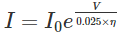


Comments
Post a Comment
Thank you for visiting😊