Elements of Translational Mechanical System and Rotational Mechanical System
Elements of Translational Mechanical System and Rotational Mechanical System
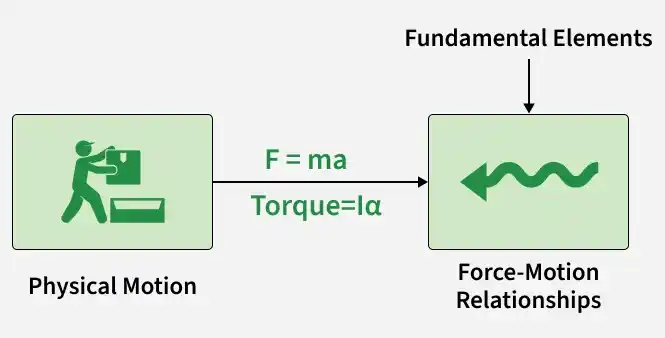
Mechanical system modelling plays an important role in control engineering and dynamic analysis. Each mechanical model consists of fundamental elements responsible for energy storage, energy dissipation, and motion control. Physical motion converts into mathematical form using force–motion relationships.
Mechanical motion mainly appears in two forms:
- Linear motion: Translational Mechanical System.
- Angular motion: Rotational Mechanical System.
Elements of Translational Mechanical System
A translational mechanical system represents motion along a straight path. Movement occurs in a horizontal or vertical direction under the action of applied force. Mathematical modelling expresses behaviour using displacement, velocity, and acceleration relations.
Motion relationships:
Three Important Elements For Translational Mechanical Systems:
- Mass Element.
- Spring Element.
- Damper Element.
Each element contributes unique dynamic behaviour.
1. Mass Element (Inertia Element)
Mass element represents inertia property of moving body. Inertia resists acceleration produced by external force.
Consider a single mass system, applied force to the mass is f(t), displacement is x(t), and velocity is v(t)
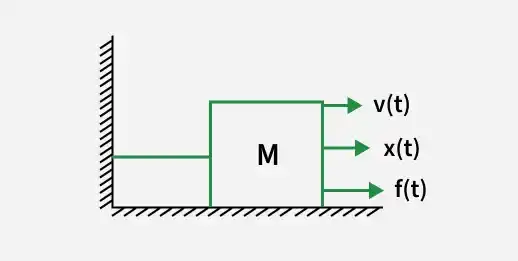
Where,
- f(t) → Input applied force.
- x(t) → Output displacement.
- v(t) → Output velocity.
- M → Mass of the object.
2. Spring Element (Elastic Element)
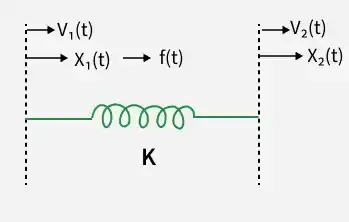
Spring element represents elasticity. Elastic force develops whenever deformation occurs. Spring is an element that is deformed (with a displacement of x1(t) and x2(t) at both ends) with a velocity v1(t) and v2(t) on both ends in direct proportion to the amount of force f(t) applied. Ideal springs have no mass.
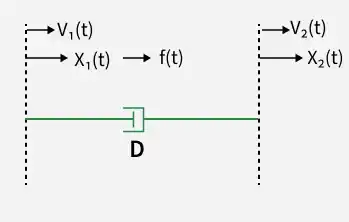
3. Damper Element (Friction Element)
Physical Interpretation of Translational Elements
- Mass controls acceleration behaviour.
- Spring governs position restoration.
- Damper removes excess vibration.
Elements of Rotational Mechanical System
Rotational mechanical system represents motion about a fixed axis. Torque replaces force, while angular displacement replaces linear displacement.
Where,
Angular motion relations:
Rotational Mechanical Systems Also Consist of Three Primary Elements:
- Moment of Inertia
- Torsional Spring.
- Rotational Damper.
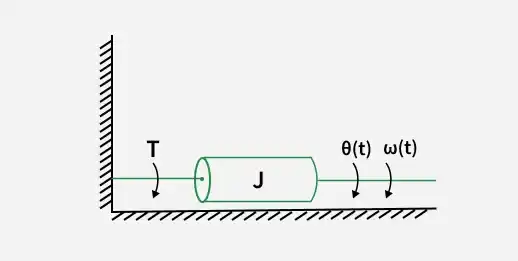
1. Moment of Inertia (Rotational Mass)
Moment of inertia represents resistance against angular acceleration.
- T = Applied Torque (input).
= Angular displacement. = Angular Displacement. - J = Moment of Inertia.
2. Torsional Spring (Rotational Elastic Element)
Torsional spring produces restoring torque proportional to angular displacement. Consider a spring element, and a torque T is applied. As a result, angular displacement at both ends is θ1(t) and θ2(t), and angular velocity is ω1(t) and ω2(t).
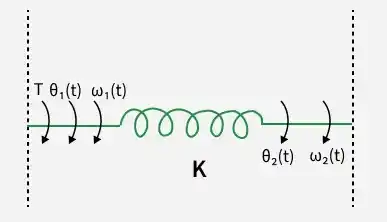
where, K is Spring Constant.
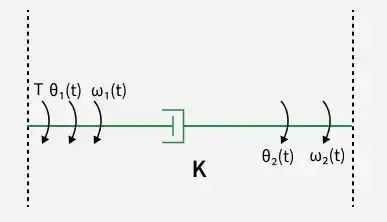
3. Rotational Damper (Viscous Friction Element)
Rotational damper opposes angular velocity using frictional torque.
Where, D = Damper constant.
Physical Interpretation of Rotational Elements
- Moment of inertia controls angular acceleration.
- Torsional spring restores angular position.
- Rotational damper stabilizes motion.


Comments
Post a Comment
Thank you for visiting😊